



Where would you like to begin?
You can always change your path in settings.
Biblical Cantillation:
In a Nutshell
Welcome to Biblical Cantillation in a Nutshell.
This course will help you understand how biblical chanting works and how to practice using this app. You do not need to learn everything before you begin. Read a little, try a little, and come back whenever you want.
The best way to learn is to hear it and try it. We’re excited to learn with you.
If you need help with the app or with cantillation, email us anytime at [email protected].
Torah and Haftarah use the same chanting marks, but the melodies are different. Choose the one you want to hear first. You can also control how the examples below sound by using the “Chant/Music” toggle on the top right. Chant plays voice recordings. Music plays keyboard sounds. You can change either of these choices anytime. If you are not sure, choose Torah.
What is Biblical Cantillation?
Biblical cantillation is the special way we chant words from the Torah, Haftarah, and other books of the Bible. Every word has at least one chanting mark, usually above or below the word. Those marks are called tropes.
Each trope mark helps the reader know how that word should be chanted. In this course, when we say trope, we usually mean both the mark you see and the sound it tells you to chant.

There are 28 trope marks in the full system. You do not need to learn them all at once.
The same trope marks are used for Torah, Haftarah, and the Book of Esther, but they do not sound the same in each one. It is best to learn one set of melodies first, such as Torah, before learning another.

Tropes help the reader in three ways: they make the words easier to remember, they show which syllable gets the strongest sound, and they show where to pause.
Learning the Sounds
The app teaches all 28 tropes in four stages. Start with one stage and get comfortable with it before moving to the next. The stages are arranged by how often these trope sounds appear. We recommend that you start with the sounds you will see most often.
Inside each stage, tropes are grouped into families. A trope family is a group of sounds that often work together. Tap a stage below, then tap the trope images to hear how they sound.
Trope Mapping
Once you know how a trope sounds, the next step is learning how that sound fits onto a Hebrew word. We call this ‘Trope Mapping.’ In Hebrew, one syllable in each word gets the main emphasis. That syllable is called the accented syllable. Most of the time, the trope mark appears above or below the first letter of that accented syllable.
Milrah means the main emphasis is on the final syllable.
Mileil means the main emphasis is on the next-to-last syllable.
Trope location usually shows which syllable gets the main emphasis. This rule will help you understand most words you see at the beginning.
Tap between the two word types below.
Trope and accent fall on the final syllable
Trope and accent fall on the next-to-last syllable
Anatomy of a Trope
In this app, a sound map is a picture of a trope sound. We read sound maps from right to left. Most trope sounds have two parts: first the “Get Ready,” then the “Go.”
Chant the “Get Ready” on each syllable before the main emphasis. Chant the “Go” on the accented syllable. The “Go” is the part that makes each trope sound different.
Let’s first look at a milrah word, where the accent is on the final syllable. The word לֵאמֹֽר (lei-MOR) has the trope Siluk. Chant the “Get Ready” on the first syllable. Chant the two “Go” notes on the final syllable. Tap the sound map to hear it.
When milrah words get longer
Tap through the examples below using the purple arrows. Notice that the “Get Ready” grows longer when there are more unstressed syllables before the accent.
Different “Go” patterns
Tap through these examples. Notice that different tropes have different “Go” patterns.
The 4-Step Method
Before you chant your first word, here is the process you will use every single time — for every word in this app, and for any cantillation you ever learn. Let's walk through it now using לֵאמֹֽר (lei-MOR) with the trope Siluk, which you just heard in Chapter 4.
Tap through the four steps, then practice what you've already learned on some real words.

the chant
the music
the music
the chant
the music
your voice
the chant
later
the music
Mileil Words
Milrah words are usually the easiest ones to handle. Mileil words can take a little more practice. That is normal. This chapter gives you the basic idea, and you will have lots of chances to practice later.
In the sound map, each dot is one sound you chant. A “Go” can have one dot or more than one dot.
For this next idea, pay attention to how many “Go” notes a trope has: some tropes have one, and some have more than one. If the word is mileil and the trope has only one dot in the “Go,” chant that same sound again on the final syllable. Here are a few examples using the trope, Kadma.
Siluk is different because its “Go” has more than one dot. The final dot in the “Go” lands on the final syllable. Here are a few examples with the trope, Siluk.
Words without Get Ready
Some words do not have any syllables before the accent. That means there is no “Get Ready.” You chant only the “Go.”
This happens with one-syllable words and with two-syllable mileil words, because the trope is at the beginning of the word.
The sound maps below show Siluk with and without a “Get Ready.”
Here are a few one-syllable Siluk examples with no “Get Ready.”
Two-syllable mileil words can feel tricky at first because they have no “Get Ready,” and you still have to decide what to chant on the final syllable. Here are a few examples with the trope, Siluk.
From Words to Sequences
Trope sounds do not usually happen one word at a time. They connect into sequences, which are groups of trope sounds in a row. Some sequences show up more often than others.
A sequence usually leads toward an important trope at the end. These examples all lead toward Siluk, the trope you have been practicing. That is why the app calls these Siluk ‘family’ sequences.
Use the arrows to move through the examples. Tap an example to hear the sequence.
Getting the Most from the App
Whenever you practice a word or phrase in Trope on the Go™, you can tap the sound map icon to see how the trope fits onto the syllables. A sound map is a picture that shows which sounds go with which syllables. The app can also play the word or phrase in a pitch range that fits your voice.
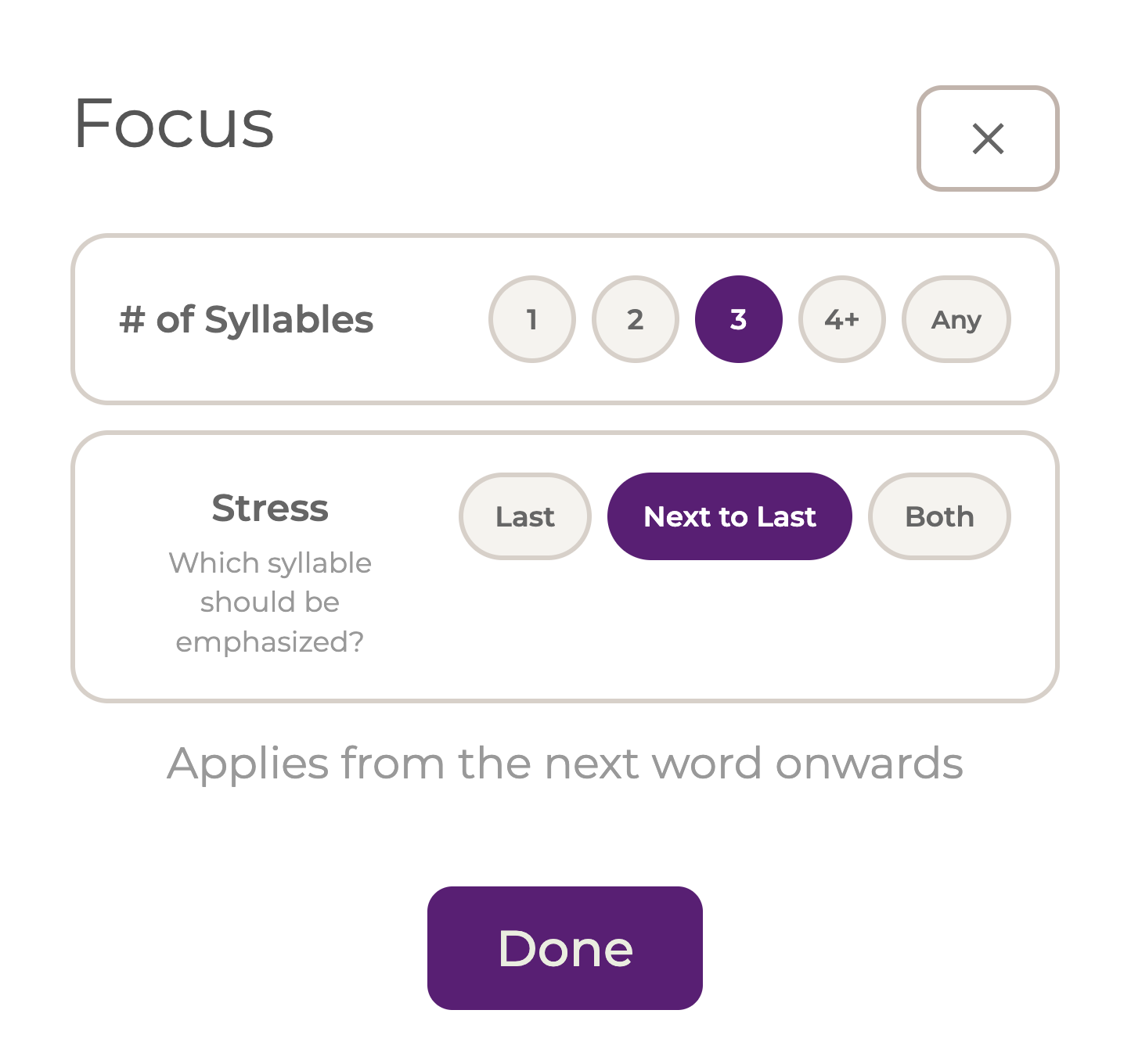
Before you start a word-practice session, you can choose exactly what kind of words you want to work on. For example, you can focus on short words, longer words, milrah words, or mileil words. Focused practice helps you learn faster. In any word-practice card, tap the  icon to adjust these settings.
When you're preparing for a specific reading, the app pulls words and sequences directly from your text, so every session is always relevant. You never waste time.
How to Study with Trope on the Go
We recommend using the flashcards in the Fun and Games section a little bit every day. Short daily review can make a big difference. From there, we recommend learning the system according to the following chart. Whenever you learn a new trope sound, immediately apply it to different kinds of words: milrah words, mileil words, short words, and longer words. When you know the trope sounds in one ‘family,’ start practicing sequences from that same ‘family.’
Individual tropes join words into sequences. Sequences join to form verses. Verses join to form readings.
| Step | Practice | Why it helps |
|---|---|---|
| 1 | Trope Sounds | Learn the sounds of the tropes. Start with Most Frequent and work your way down. |
| 2 | Word Practice | Apply the sounds to real Hebrew words. |
| 3 | Sequence Sounds | Learn how tropes work together in families. |
| 4 | Phrase Practice | Practice full trope sequences on real text. |
| 5 | Your Reading | Practice the words and sequences you’ve learned inside real verses, with the words around them, so you see them the way they will appear in the text. |
Then repeat the same process with the next trope ‘family.’ Keep working down the colored stages from top to bottom. Little by little, the whole system will start to make sense.
Next Steps
You’ve now seen the main ways Siluk can work on different kinds of words and sequences. Here are the best next steps for continuing your learning:
You can skip steps you've already done.
Happy leyning! Leyning is the Yiddish word many people use for chanting Torah.
Welcome back to Biblical Cantillation in a Nutshell
You left off in the course. Would you like to continue where you left off, or start over from the beginning?
Let's find your natural singing range.
We'll use "Happy Birthday" to find your natural voice. Select your microphone, and, when you're ready, tap the button and sing along with the on-screen words.
Play a sample trope sequence in your calibrated key to see if it sounds right. You might want to try singing along to make sure it's comfortable. If so, tap save and continue. If not, tap start over and try again.
Choose Torah or Haftarah, then make a selection from the Learn or Practice sections below.
*Note to professional users: trope groupings here reflect their frequency in the text rather than strict adherence to their disjunctive levels.
*Note to professional users: trope groupings here reflect their frequency in the text rather than strict adherence to their disjunctive levels.
*Note to professional users: trope groupings here reflect their frequency in the text rather than strict adherence to their disjunctive levels.
You can change your reading any time using the Settings button.
Session Complete
Here's how you did:
Trope Fun and Games
Trope Dictation
Listen to the trope, then place the matching symbol in the answer slot.
Difficulty
Choose how many distractor tropes should appear.
Listen carefully, then drag the matching trope into the slot.
Results
Trope Sequencing Game
Drag the tropes into the correct sequence, then submit and listen to what you did. If you don't get it right away, you can rearrange the tiles and try submitting again.
Difficulty
Choose which sequences to practice.
Drag the tropes into the correct sequence, then submit and listen to what you did. If you don't get it right away, you can rearrange the tiles and try submitting again.
Results
Trope Catcher
Hear the trope, then catch as many matching bubbles as you can.
Listen, then tap as many matching bubbles as you can in 60 seconds.
Smaller, faster bubbles are worth more points.
Round Over
Trope Flashcards
Learn trope symbols and names with a steady review deck that grows as you master the cards.
Active Cards
You can click here to change this number at any time. We recommend a maximum number of 6-8 new cards per session at first and then gradually increase the number as you gain mastery.
Trope Matching
Build symbol-and-name fluency by matching the trope names to the correct signs.
Difficulty
Choose which trope group to practice.
Choose the trope name that matches the symbol.
Match the prompt to the correct choice.
Results
Milrah / Mileil Sort
Read the Hebrew word, then sort it by stress. Is the trope on the final syllable or the next-to-last one?
Reminder: "Milrah" describes words that have the final syllable accented. "Mileil" describes words that have the next-to-last syllable accented.